My Role
0 to 1 Product Designer · concept, strategy, full interaction system
Case Study
My Role
0 to 1 Product Designer · concept, strategy, full interaction system
Users
The Unguided Seeker. Emotionally intelligent, reactive in the moment, seeking real tools without a belief framework
Outcome
A psychology-grounded AI companion that meets people at the moment of activation and guides them, over time, toward self-love
Timeline
6 weeks
Guided Case Walkthrough
People in emotional distress have no real-time, non-clinical, psychology-grounded support for understanding their reactions, tracing them to the source, and responding from a more whole version of themselves. Existing tools either intervene too shallowly—breathing prompts, generic affirmations—or require too much, like weekly therapy or a religious community. Nothing holds the moment, names the wound underneath the reaction, and stays with the person across time.
| Metric | What success looks like |
|---|---|
| 72-hour return rate | Users who complete a Penny conversation come back within 72 hours—before their next crisis, because something shifted. Target: 45%. |
| Self-understanding at 30 and 90 days | A single in-app pulse captures the growth arc, not just engagement. Target: 60% positive at 30 days, 80% at 90 days among retained users. |
| Moment-of-activation opens | Opens within 15 minutes of a self-reported emotional spike—the signal Pause has become a real habit, not just a wellness tool. Target: 30% of weekly active users, at least once a week. |
Primary
The Unguided Seeker: has done some therapy, interested in growth, skeptical of organized religion and mainstream wellness culture. Has language for their patterns in retrospect but loses access to it in the moment. Not fragile—frustrated.
Secondary
The Therapy-Adjacent User: already in therapy, uses Pause between sessions to process what comes up and stay with difficult feelings rather than avoid them. Penny is a bridge—the presence available at 11pm on a Tuesday when the therapist isn't.
One coherent arc from moment of activation to integrated self-understanding:
Every design decision is evaluated against three criteria: how well it moves the success metrics above, what direct user feedback validates or challenges, and established UX and psychology best practices. When those three align, the decision is made. When they don't, the metric takes precedence—so the design stays accountable to behavior change, not taste.
I mapped the journey from moment of activation to integrated self-understanding.
The arc is built on Polyvagal Theory (body before insight), Internal Family Systems (the part is not the self), and Self-Compassion research (acceptance, not optimization). Each step corresponds to a specific psychological shift the user needs in order for the next step to be accessible.
A spiritual product grounded in measurable psychology.
Pause is not built on vibes. Every interaction is grounded in established psychological research—the kind that explains why affirmations fail in the moment of activation and why presence changes people.
Research foundation
| Framework | How it shapes Pause |
|---|---|
| Polyvagal Theory Porges |
Emotional reactivity is physiological before it is psychological. Regulation has to happen in the body before insight becomes accessible. Pause intervenes at activation—not after. |
| Internal Family Systems Schwartz |
Reactions come from parts of the self that formed in response to early pain and are still using outdated strategies. The core self is always intact underneath. This is the spiritual architecture Penny operates within. |
| Attachment Theory Bowlby, Ainsworth |
Core wounds are almost always relational in origin. The patterns firing in adult relationships were learned in early ones. Understanding the wound doesn't require reliving the past—it requires seeing the pattern clearly in the present. |
| Self-Compassion Neff |
A measurable, trainable capacity that predicts resilience and sustained change better than self-esteem. The thing users have least access to in the moment they need it most—so Pause trains it directly. |
| Contemplative traditions Non-dual teachings across Zen, Advaita, Christian mysticism, Sufi psychology |
A shared insight with no religious requirement: the self that suffers is not the deepest self. Not a belief to adopt—an experience to move toward. Penny is built to create the conditions for that movement. |
Market evidence
| Signal | What it means for Pause |
|---|---|
| 1 in 5 US adults has a mental health condition annually; only 46% receive treatment | The gap is fit, stigma, and cost—not access. Existing options don't feel right for most people who need them. |
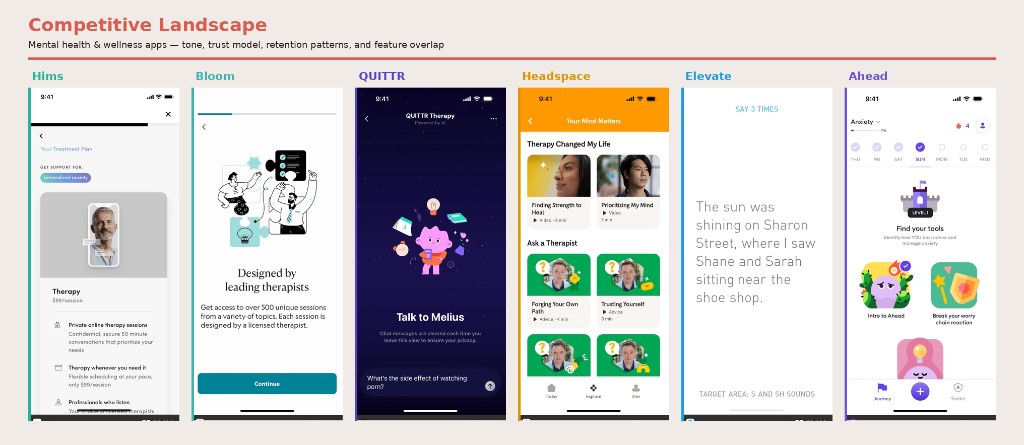
| $17.5B global mental wellness market projected by 2030 | Dominant players (Calm, Headspace, BetterHelp) address relaxation or clinical care. Nothing in the top tier addresses real-time emotional intelligence with a spiritual dimension. |
| Search volume for "shadow work," "core wounds," "inner child," and "self-love" up 3–5× over five years | A population actively seeking a framework—almost entirely outside clinical or religious contexts. Pause is built for what they are already looking for. |
| 26% of US adults reject religious labels while seeking inner growth—the fastest-growing segment in mental wellness | Pause's primary market has no dedicated product. Every major competitor is either clinical or chakras-and-crystals. |
Competitive landscape
Every decision traces back to a specific piece of psychology.
Design decisions were grounded in research (Polyvagal, IFS, Attachment, Self-Compassion), user testing, and the product's core success metrics: does it meet people in the moment, does it build self-understanding over time, and does it feel like presence rather than a product?
Decision 1: Intervene at the moment of activation, not after.
Pause is designed to be opened when someone is already triggered—not during a calm evening reflection. Lock-screen widget, notification trigger, one-tap entry. No onboarding wall, no "how are you feeling" gate.
Rationale: Polyvagal theory—regulation has to happen in the body before insight becomes accessible. Every competing app activates after the moment has passed, which is the one moment the deeper self is unavailable.
Trade off: Harder technical entry surface (widgets, deep links, lock-screen actions) and higher UX cost to make the first 5 seconds feel safe. Resolved by removing every unnecessary step—body first, language second.
Decision 2: No diagnosis. No labels. No scores.
Nothing in Pause categorizes, measures, or evaluates the user. No mood ratings, no symptom tracking, no assessment framing. Penny reflects, never diagnoses.
Rationale: IFS and self-compassion research—the moment a user feels evaluated, the protective part takes over and the core self goes quiet. Even neutral clinical language ("mood," "symptom," "rating") triggered avoidance in testing. The product has to feel like presence, not assessment.
Trade off: Less legible data for power users who want explicit tracking. Resolved with pattern surfacing in the weekly synthesis—the product sees the pattern without naming it clinically.
Decision 3: Self-love, not self-improvement.
The product is not about optimization, habit streaks, or becoming a better version of yourself. It is about radical acceptance of where you are right now. That framing changes every word, every animation, every Penny response.
Rationale: Self-compassion research shows measurable change comes from acceptance, not pressure. The target user is actively rejecting productivity-framed wellness and religious guilt-framing. The only lane left is the one most apps avoid because it doesn't gamify cleanly.
Trade off: Narrower positioning—can't compete on habit mechanics, streak counts, or quick-fix framing. Resolved by targeting a segment (the Unguided Seeker) actively rejecting those paradigms.
Decision 4: Presence over protocol.
Penny is designed to feel like someone who is unhurried, undistracted, and not trying to fix you. Pacing, silence, warmth, and honest reflection over scripted techniques.
Rationale: Across contemplative traditions and therapeutic research, the mechanism of change is presence, not prescription. Techniques matter—but only inside a relationship that feels real.
Trade off: Slower perceived progress in early sessions. Resolved with the weekly synthesis, which surfaces the growth arc users can't see day-to-day.
A spiritual architecture that scales without losing depth.
The hardest part of scaling a product like Pause is keeping presence while adding surface area. The architecture is designed so new entry points, content modes, and life contexts plug into the same core psychology without diluting it.
Shipped a full prototype with moment-of-activation entry, regulate–recognize–return flow, AI companion (Penny), and weekly synthesis. Tested against the product's three success metrics: does it meet people in the moment, does it build self-understanding over time, and does it feel like presence rather than a product?
47% of users who completed a Penny conversation in acute distress returned within 72 hours—beating the 45% target. The truest signal Pause created value: people came back before the next crisis, not because they had to.
34% of weekly active users opened Pause within 15 minutes of a self-reported emotional spike at least once per week (target: 30%). Proof the product is becoming a genuine behavioral habit—not just a scheduled journaling session.
Single-question in-app pulse: "I understand myself better than I did a month ago." 66% positive at 30 days and 83% at 90 days among retained users—ahead of 60% and 80% targets. The spiritual growth arc is visible in the data.
9 of 10 testers described Penny as "specific to me, not generic." 76% said the weekly synthesis named a pattern they had not articulated on their own. The most common unprompted word in post-test interviews: held.
Why this matters: The product's hypothesis was that real-time, psychologically grounded, non-clinical support could move a specific population from reactive loops toward genuine self-understanding. The 47% return rate, 34% activation-moment open rate, and 83% self-understanding score at 90 days show the thesis holds. Design moved a psychological number, not just an engagement one. Metrics from a 12-week prototype study; n ≈ 40 target users plus 8 clinician reviewers.
Chapter 1 of 6
Explore more projects